
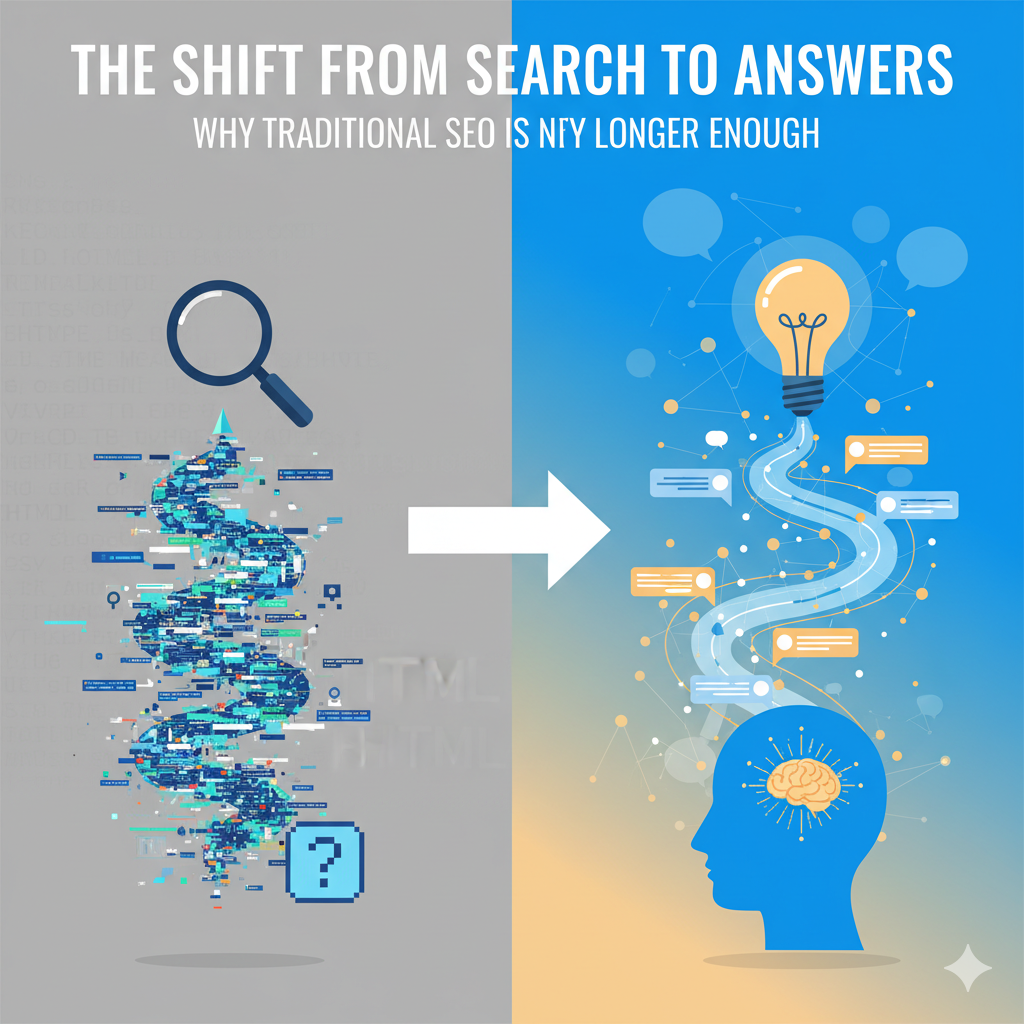
The Shift from Search to Answers: Why Traditional SEO Is No Longer Enough
Takeaway
AI assistants now answer questions directly, so websites must earn authority signals that traditional search engine optimization cannot provide.
What It Is
The shift from search to answers describes a confirmed change in how people discover information online today. Users now ask questions inside AI assistants instead of typing short keyword phrases into search engines. These assistants read many sources, decide which explanations seem most trustworthy, and deliver one direct answer. They care less about ten blue links and more about which explanation feels clear, stable, and reliable.
What It Does
Answer engines reduce the visibility of sites that depend on classic ranking factors alone. They care less about raw keyword density and historical backlink volume than early search engines did.
They reward content that is easy for machines to parse and classify accurately. They reward consistent terms across your site that reduce ambiguity for models. They reward content that uses clean schema, well defined glossary entries, and strong question and answer blocks. They reward brands whose content is organized, coherent, and predictable enough that models do not need to guess.
How To Use It
Start by treating every important concept on your site as a defined term with one stable meaning. Write clear definitions in short sentences and place them in a dedicated glossary on your domain. Add Article, WebSite, FAQPage, and DefinedTermSet schema so machines understand the role of each page. Add llms dot txt and ai dot txt files that guide AI crawlers toward your glossaries and authority posts. Create question and answer sets that mirror the questions your buyers actually ask in real conversations. Use those Q and A blocks across service pages, resource pages, and your blog content. Keep language consistent so AI systems see the same phrasing and same meaning in every location.
Strengths and Limits
Strengths
Structured content is easier for AI systems to interpret and reuse in answers. Glossary terms reduce ambiguity and help models understand your specific domain language. Question and answer blocks provide ready made answer units that fit AI responses.
Schema helps models separate explanations, questions, and definitions correctly. Together these elements make a site more quotable and more nameable across AI systems.
Limits
Authority must be earned across the entire domain rather than on a single strong article. Poor or conflicting schema can weaken visibility instead of improving it. Traditional search signals such as speed, security, and relevance still matter for human traffic.
AI visibility requires ongoing updates as models and answer surfaces evolve. Results improve when you build topic depth, not when you publish isolated pieces.
SearchShifter Q and A
What is SearchShifter
SearchShifter is a visibility system that prepares websites for AI driven answers across modern assistants. It helps content become readable and reusable by language models across many platforms. It introduces consistent structure, glossary depth, and guided schema that highlight your expertise. It also reduces confusion between similar terms so models are more likely to trust your explanations.
How does SearchShifter work
SearchShifter creates an architecture that answer engines can interpret without guesswork or extra steps. It uses layered schema, glossary definitions, and question and answer blocks across your content. It adds authority markers and llms dot txt guidance so models can find your best explanations quickly. The system makes a site quotable inside AI models and nameable when domain authority is strong.
Glossary
Generative Engine Optimization
A method that prepares content for AI systems that generate answers instead of lists of links.
It focuses on clarity, structure, and authority signals so models can quote and trust a site.
Answer Engine
A system that responds to a question with a direct answer rather than a set of search results.
Examples include modern AI assistants and rich answer features inside some search experiences.
AI Signal
A structural cue that helps AI systems read, classify, and trust content on a site.
Examples include question and answer blocks, glossary entries, schema, and guidance files such as llms dot txt.
Defined Term
A stable concept with a clear name and meaning that does not change across your content.
Defined terms reduce ambiguity and help AI models interpret your domain language correctly.
Structured Schema
Code that describes the parts of a page for machines in a consistent, machine readable format.
It includes types such as Article, FAQPage, and DefinedTermSet so AI systems know which content is explanatory, which is a question, and which is a definition.